01 · The idea
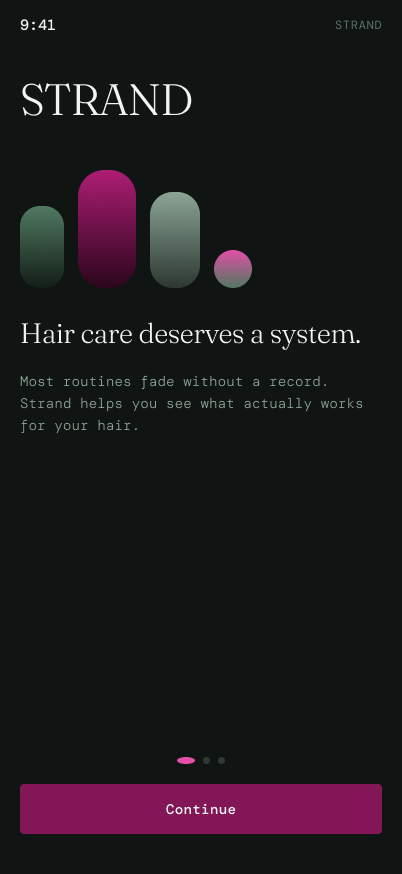
Hair care deserves a system
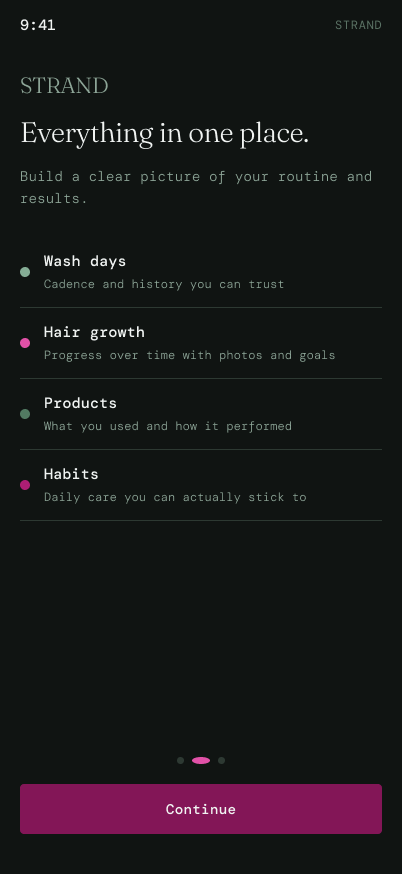
Hair care routines are easy to start and easy to lose track of: which products worked, how long wash day actually took, whether a habit stuck. Strand is a lightweight tracker for exactly that: wash-day logs, a routine timer built from reusable steps, product usage (including barcode scanning), hair-growth progress, and daily habits, all in one place, with the history to show what's actually working.
Wash-day logging
Routine & step builder
Barcode product scan
Growth & habit tracking
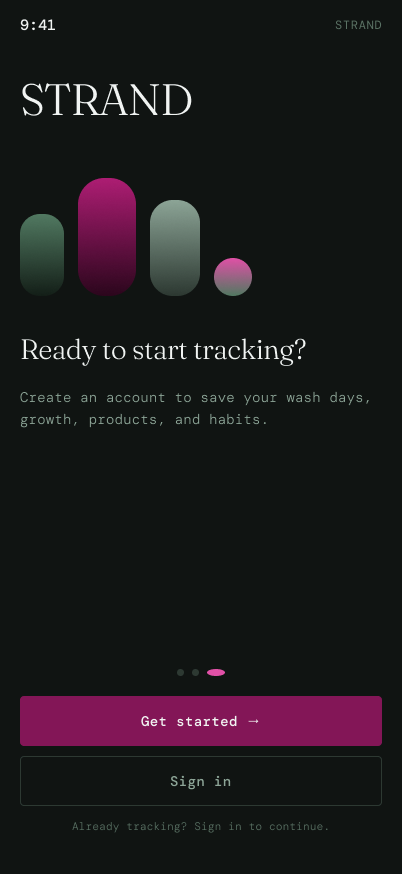
Guided onboarding
Push notifications
02 · Building with AI
From empty repo to full product
Strand was built end-to-end by one person, with AI tools standing in for the roles a small startup team would normally fill: engineer, designer, and QA. Every layer of the stack (UI, backend schema, auth, analytics, native packaging) was built through an AI-assisted workflow rather than a traditional team.
Claude Code
The primary build engine. Used to write and ship full features directly in the codebase: the routine/step picker, Mixpanel event instrumentation, the password-reset flow, and a rebuild of the product barcode-scan lookup into a self-healing, cache-first chain when the original flow proved flaky.
Cursor
In-editor AI pairing for faster iteration on the single-page app (index.html), used alongside Claude Code for quick fixes and inline changes during active development sessions.
Figma (MCP-driven design)
Onboarding and splash screens were generated and iterated on directly through an AI-driven Figma workflow, producing the dark, editorial look carried through the whole app, with no separate design tool hand-off required.
Supabase MCP
Database schema and migrations (onboarding tooltip state, push notification subscriptions) were authored and applied directly from the AI agent against the live Postgres backend, skipping a manual admin-console workflow entirely.
“The bottleneck was never ‘can this be built.’ It was staying decisive enough to keep briefing the AI clearly. Once that clicked, a single founder could carry frontend, backend, analytics, and a native app release at the same time.”
On building Strand solo
03 · How it shipped
Four months, one loop
04 · What shipped
A product, not a prototype
-
Wash-day logging
Routines built from reusable, timed steps with a duration ring.
-
Product tracking
Barcode scan (native + web fallback) with a cache-first lookup chain.
-
Growth & habits
Progress photos and daily-habit tracking.
-
Guided onboarding
First-time-only, Next-driven tour.
-
Auth
Accounts with a working password-reset flow.
-
Push notifications
Opt-in for new and existing users.
-
Analytics
Mixpanel funnels/dashboards + Vercel Analytics.
-
Native app
iOS build via Capacitor from the same codebase.
Stack
FrontendSingle-page PWA (vanilla JS)
BackendSupabase (Postgres + Auth)
NativeCapacitor (iOS)
ScanningML Kit + ZXing web fallback
AnalyticsMixpanel + Vercel Analytics
HostingVercel
DesignFigma (AI-generated screens)
Build toolsClaude Code, Cursor
05 · Why it matters
One person, a full stack
Strand shows what a non-engineer-led, one-person team can now ship: a real multi-platform product with auth, a live database, analytics, and a native app, not a prototype. AI tools collapsed the roles that used to require a team into a single, fast build loop.